
Consolidation is only part of the story
The UK financial services M&A market continues to attract significant buyer interest. But while consolidation remains an important theme, the rationale behind transactions is becoming more nuanced.
M&A Activity | 2022 – 2025
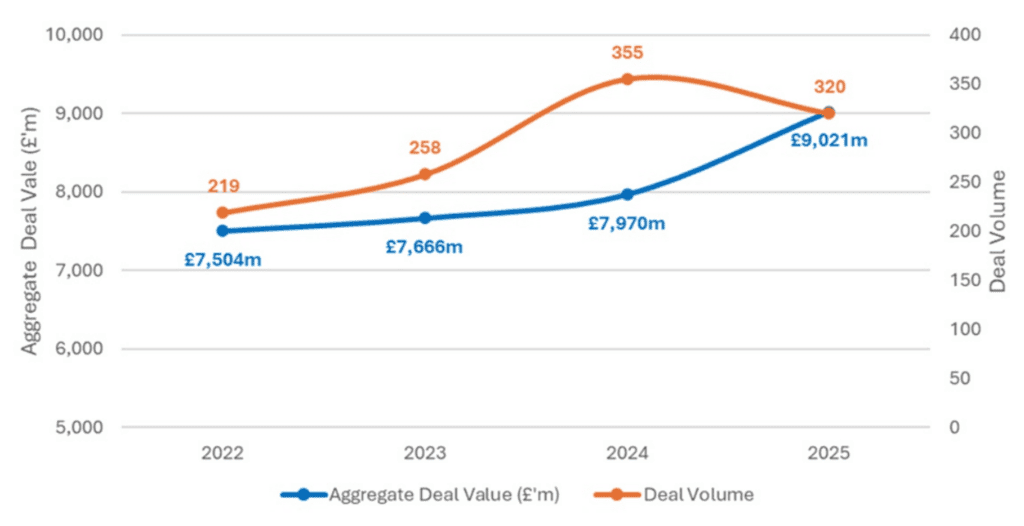
Source: Merger Market (2026)
UK mid-market financial services deal value increased from £7.5bn in 2022 to £9.0bn in 2025. Deal volumes also increased over the period, starting at 219 transactions, peaking at 355 in 2024, before falling to 320 in 2025.
The combination of higher aggregate deal value and fewer transactions in 2025 suggests that buyers are becoming more selective about where they deploy capital. Businesses are being acquired not simply because they add revenue or scale, but because they provide something strategically valuable: recurring earnings, customers, technology, specialist expertise or a platform for further growth.
So, what is driving financial services deals today?
Why is scale still important in financial services M&A?
Consolidation remains one of the clearest features of financial services M&A.
In sectors such as wealth management, financial advice and insurance broking, many markets remain highly fragmented. Larger groups can spread regulatory, compliance, technology and operational costs across a broader revenue base, while also having greater resources to invest in people, systems and growth.
For buyers, acquiring a smaller business can therefore be an efficient way of adding clients and revenue while strengthening an existing platform.
However, scale alone is no longer enough. Buyers increasingly need to demonstrate how an acquisition will improve the wider business. The more important question is what the additional revenue brings with it: attractive clients, recurring income, geographic reach, specialist capabilities or opportunities for cross-selling and operational synergies.
The focus is shifting from buying scale to creating value from scale.
How is technology influencing financial services acquisitions?
Technology and AI are also becoming increasingly relevant to financial services M&A.
EY reported that 25% of UK financial services CEOs identified enhancing technology or AI capabilities as their most important M&A driver in 2026.
For established financial services businesses, acquiring technology or technology-enabled capabilities can be considerably quicker than developing them internally. An acquisition may provide access to specialist employees, intellectual property, data and established customer relationships alongside the technology itself.
This is changing the role of M&A. Transactions are increasingly being used to accelerate strategic objectives rather than simply increase revenue.
For owners, this creates an opportunity to think about their business beyond its current financial performance. Differentiated technology, proprietary data, strong systems or specialist expertise can make a relatively small business strategically valuable to a buyer.
Why do recurring revenues attract higher valuations?
Despite the increasing focus on technology and strategic capability, one traditional characteristic remains highly valued: earnings visibility.
Financial services businesses with recurring or repeatable revenue, strong client retention and good visibility over future income continue to attract significant interest.
A business does not need to have 100% recurring revenue. Buyers want confidence that the earnings being acquired are sustainable and that there is a clear basis for future growth.
Two businesses with the same EBITDA can therefore command very different valuations. Strong client retention, diversified revenue, predictable income and limited reliance on a small number of individuals can give a buyer significantly greater confidence than a business where earnings depend heavily on new business or a handful of key relationships.
This is particularly important in financial services, where the quality of client relationships and the ability of advisers or management to retain those relationships can be central to value.
What role is private equity playing in financial services consolidation?
Private equity remains an important source of capital for financial services consolidation.
The buy-and-build model is particularly suited to fragmented sectors. An investor can acquire a platform business, provide capital and infrastructure, and then use further acquisitions to build scale. Eventually, the platform itself can become an attractive acquisition target.
We have seen this first-hand.
Our Corporate Finance team recently advised the shareholders of Absolute Sense Independent Financial Advisers on its sale to Beckett Investment Management Group. The transaction gave Beckett an established East of England presence, experienced advisers and established client relationships, alongside more than £135m of assets under advice. Read our full article on the transaction [here].
The transaction formed part of a broader consolidation strategy. Beckett subsequently continued to expand through further acquisitions and, in 2026, Foresight sold a majority stake in Beckett to WestBridge following a period of significant organic and acquisitive growth.
Foresight reported that Beckett had increased assets under management from £0.8bn to £2.1bn during its investment period and completed seven acquisitions. Foresight achieved more than 5.0x invested capital while retaining a minority stake in the business.
The journey illustrates an important point about M&A in financial services: an acquisition can be valuable not only for the earnings and clients it contributes directly, but also because it strengthens the wider platform and supports a longer-term value-creation strategy.
What happens after the first wave of consolidation?
This raises an interesting question about what happens as financial services platforms become larger.
The next stage of consolidation may increasingly involve the consolidators themselves. As platforms mature, their owners may look to realise value through a sale to a larger private equity investor or strategic buyer, while continuation vehicles may also provide an alternative route to liquidity in some circumstances.
At the same time, mature groups may reassess activities that no longer fit their long-term strategy, potentially creating opportunities for disposals and further M&A.
The market could therefore increasingly operate at multiple levels: consolidators acquire smaller businesses, larger investors acquire consolidators, and mature platforms reshape their portfolios.
How is regulation influencing M&A activity?
Regulation is another factor influencing consolidation.
The cost and complexity of maintaining appropriate compliance, governance and operational infrastructure can be significant, particularly for smaller financial services businesses. Scale can help spread these costs and provide access to greater resources and specialist expertise.
However, consolidation does not remove regulatory risk. As groups grow, integration, governance and oversight become increasingly important. For buyers, the challenge is therefore not simply to acquire businesses, but to integrate them effectively while maintaining service quality, regulatory standards and client relationships.
What does this mean for business owners?
For owners considering a sale, being in a high-interest financial services sector does not automatically result in a premium valuation. Buyers are becoming increasingly selective about the businesses they acquire and the strategic value those businesses can provide.
Strong recurring or repeatable revenues, high client retention, a diversified customer base, robust management teams and good-quality financial information can all improve buyer confidence. Technology, specialist expertise and geographic presence can provide additional strategic value.
Most importantly, owners should consider these factors before deciding to sell.
Building a business that is easier to acquire is often the same as building a better business: reducing reliance on individuals, strengthening management, investing in systems, improving revenue visibility and demonstrating sustainable growth.
Key takeaways for financial services business owners
Financial services M&A remains highly active, but buyer priorities are evolving. While consolidation continues to drive deal activity across wealth management, financial planning and insurance sectors, buyers are increasingly seeking businesses that offer strategic advantages beyond scale alone.
Buyers are increasingly looking for capability, technology, predictable earnings and future growth, while investors are beginning to consider what comes after the consolidation itself.
For business owners, this creates an opportunity. The businesses most likely to attract strong interest will not necessarily be the largest, but those that can clearly demonstrate why they are strategically valuable to the next owner.
For shareholders considering a transaction, understanding that value proposition early can make a meaningful difference to both the interest generated and the outcome achieved.