
The Charity Commission has published its second Charity Sector Risk Assessment following that published in 2025. The report acknowledges the both the impact of the sector and the continuing challenges.
The structure of the report follows that of the assessment in 2025 and uses casework, annual returns and other data to update the assessment.
Financial resilience
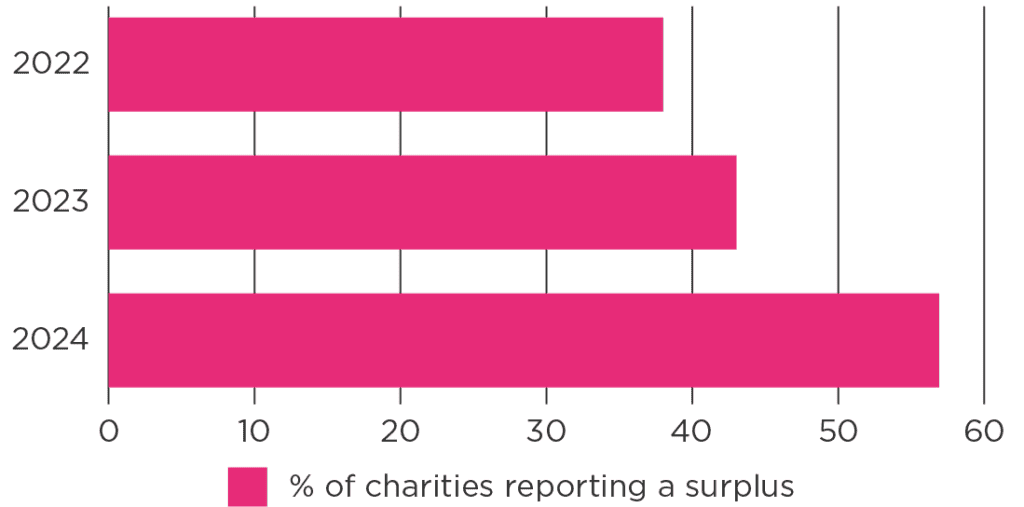
The 2024 data, the Charity Commission reports, shows increased income and expenditure, although expenditure outpaced income growth by a small margin indicating a continued financial squeeze. Whilst 41% of charities reported a deficit in 2024, there is an increasing number of charities reporting surpluses over the past three years.
- More government contracts and grants, with concerns about delivery expectations and fixed budgets precluding full cost recovery.
- A 27.7% increase in casework relating to financial difficulty between October 2024 and September 2025.
- Changes in donor behaviour leading to one-off donations rather than sustained giving.
The Charity Commission has a range of guidance on-line to support trustees in having a clear picture of the charity’s finances from which to identify significant risks. The Trustee Finance Toolkit – Advice and guidance for charity trustees is a good place to start with guidance on resilience, reserves and internal financial controls.
Risk to public benefit
This risk to public benefit has been split in 2026 to focus separately on individuals, and in particular, attempts to use a charity for private benefit; and what the Charity Commission has termed
structural vulnerabilities. Alleged abuse of charitable status by individuals continues to be a significant cause for concern with the number of cases increased from 211 to 374 from 2022 to 2024.
As a regulator, the Charity Commission is addressing this risk at registration with less than half of applications being approved.
As trustees, understanding the purpose of each activity for public benefit, strong financial controls and management of conflicts of interest, particularly around payments to trustees, helps to mitigate
the risk.
The Charity Commission has identified structural vulnerabilities in the sector arising from the multiplicity and complexity of regulation and oversight, and potential cracks and gaps a fraudster or ‘bad actor’ may take advantage of. Through casework, the Charity Commission has highlighted three specific areas. A charity working in these areas should ensure that these risks form part of their risk assessment and management:
- Social housing
- Care services
- Out-of-school settings.
| 2026 | 2025 | ||
|---|---|---|---|
| 1 | Governance risks | 1 | Governance risks |
| 2 | Safeguarding risks | 2 | Safeguarding risks |
| 3 | Social tensions | 3 | Fraud and other financial risks |
| 4 | Charities operating overseas | 4 | Emerging technology and cyber risks |
| 5 | Geopolitical turbulence | 5 | Social tensions |
| 6 | Hostile foreign states | 6 | Charities operating overseas |
| 7 | Emerging technology and cyber risks | 7 | Geopolitical turbulence |
| 8 | Hostile foreign states | ||
Other threats and risks
Whilst governance and safeguarding remain key, the 2026 report focuses on the risks to charities, staff and volunteers through geopolitical turbulence and the resultant social tensions or hostility creating risks of physical threats or threats to reputation through social media manipulation. Casework in governance risks has seen a shift from concerns about decision-making or breaches to managing dispute. The Charity Commission point to financial pressures, societal tension and challenges in recruiting trustees as part of the reason for the 57% increase in
dispute cases.
Safeguarding concerns continue to account for about 25% of all cases. The Charity Commission recommends that trustees take care when handing allegations related to individuals in positions of power and influence.
The report highlights that the Charity Commission will continue to support charities negotiating social tensions and working where the public may be hostile to their work, where decisions are made in good faith and guided by the charity’s best interests. Guidance on how charities can respond to the current hostile environment was published in December 2025. The impact of Geopolitical turbulence is seen in both social tensions at home and risks to those working overseas.
Aid Worker Security Report 2025 – Defenceless: Aid worker security amid the humanitarian funding collapse | Humanitarian Outcomes highlights the funding crisis overseas aid following the loss of US government funding and increasing violence against aid workers, the sector risk assessment points to Charity Commission briefings which can support Charities operating overseas. The report also calls attention to the Charity Commission Statement and guidance for charities on the evolving situation in Iran and the need to protect the sector from the risks of being exploited.
Although emerging technology and cyber risks are the last in the list, the Charity Commission reminds trustees that AI, technology and cyber security remain their responsibility. The Cyber security breaches survey 2025 states that in the past year 30% of charities reported experiencing a cyber attack, with phishing being the most common and disruptive type. There has also been a notable increase in ransomware attacks, whilst misuse of AI could contribute to increased risks to charity beneficiaries and employees.
Next steps
Trustees should consider the sector risk assessment as applied to their activities and environment and ensure that appropriate risks and mitigations are in place.
If you would like to discuss how PEM can support your charity, please get in touch.